

Ranging from high frequency HAB and water quality monitoring to various biomedical and biotechnology research applications. The CytoSense XR can be deployed from a central laboratory to a small field lab, providing speedy and continuous analysis. Additional deployment options are possible with the mobile CytoSense-C, the submersible CytoSubs and the CytoBuoy floating instrumentation buoy.
Advantages over typical flow cytometers or dynamic imaging devices:
Detailed information and examples on the quality of CytoSense counting, scanning and imaging can be found on the data quality page.
The CytoSense is accompanied with user friendly software for data processing & analysis. Detailed information on the data gathered with the CytoSense can be found on the data page.
The CytoSense can be accompanied with various accessories, ranging from solutions for atline or multi-sample operation and automatic fluorescent staining. Explore these on our products page or contact us for information on all available options.
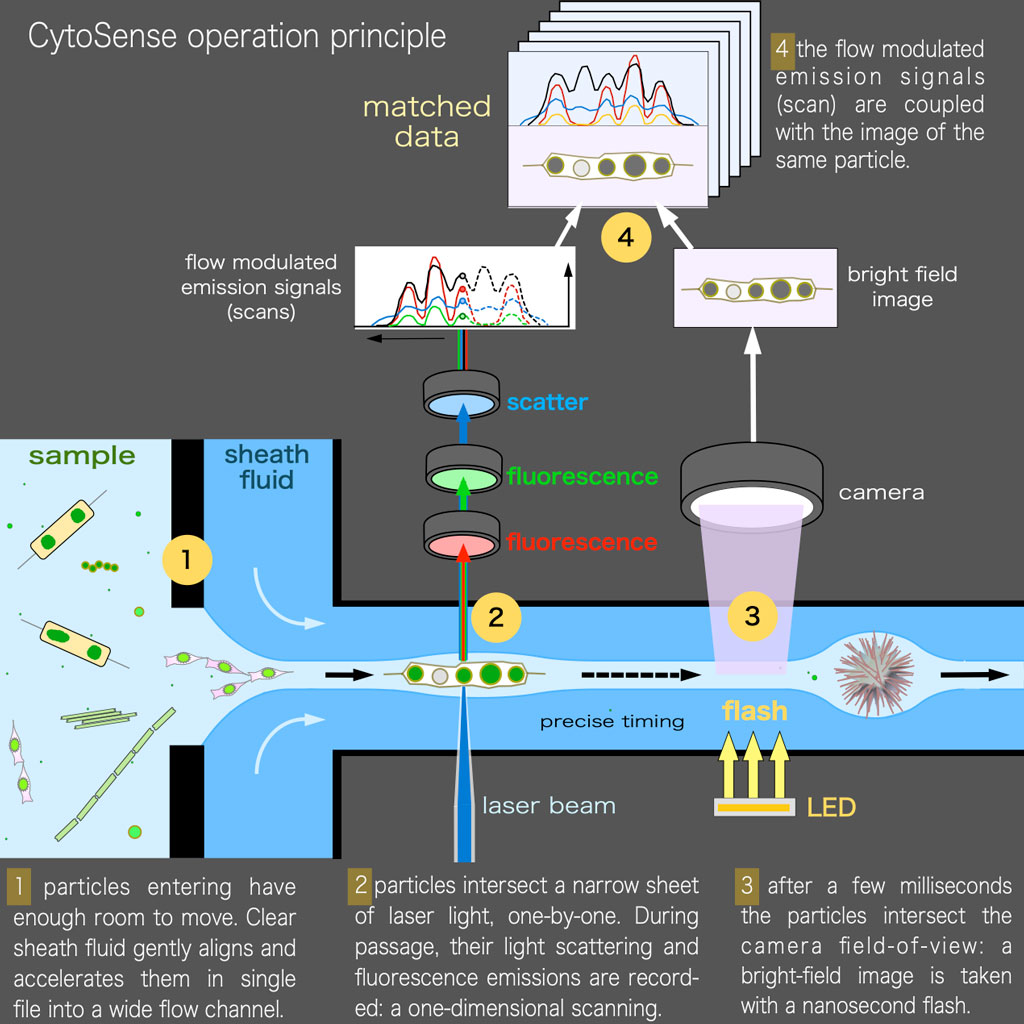
Laser scanning detects sub-micron particles and works up to large particle length (0.1µm to 800 µm diameter vs. 2500 µm length). Photo’s from 1 µm to max 778 µm.
Single cells up to colonies. Wide range of sample flow rates (0.07-16 µl/s) allows low to high particle loads
Recording scatter and fluores- cence properties of EVERY particle passing the laser beam (up to 10 000 particles per second) allowing quick and detailed analysis of cells.
Optical resolution < 1µm, 3.3 to 4.6 pixels/µm, 2.3 – 5.3 Mpixel sensors, 528 – 778 µm field of view.
No need for pre-filtration due to specially designed fluidics with 800 µm diameter minimal orifice throughout
Maintenance free, antifouling sheath fluid design keeping the flowcell free of biofilm buildup.
version for many applications. Multiple laser/detector versions available with the CytoSense C and the CytoSubs, and from 2023 for CytoSense XR.Upgradable with staining module, sampling automation & other accessories.
To support harmonisation across the community, Dr. Veronique Creach (Cefas) is developing a Terms of Reference (TOR) within the ICES Working Group on Phytoplankton and Microbial Ecology (WGPME): “Create a guide for determining consistent plankton observations at high frequency.”
High-frequency flow cytometry and imaging are increasingly used to characterise phytoplankton diversity, including community cell-size structure. This approach aligns with the GOOS-edited (2025) Essential Ocean Variable Specification Sheet and supports higher-order products such as Phytoplankton Functional Types. As autonomous, high-sampling deployments expand, shared best practices for
collection, measurement, and analysis are essential.
To support harmonisation across the community, we are developing a Terms of Reference (TOR) within the ICES Working Group on Phytoplankton and Microbial Ecology (WGPME): “Create a guide for determining consistent plankton observations at high frequency.”
Who we’re looking for: CytoBuoy users (any platform or configuration).
What to share: sampling workflows, calibration/QA approaches, processing pipelines, metadata practices, and lessons learned from autonomous/high-frequency deployments.
Why participate: help establish consistent methods and improve
comparability across datasets and regions.
If you use a CytoBuoy instrument and would like to contribute, please contact Dr Veronique Creach (veronique.creach@cefas.gov.uk) or Nicole Poulton (npoulton@bigelow.org). A brief note describing your instrument configuration and use case is enough to get started.